Office occupancy is beginning to recover following the summer holiday period. However, employers’ approaches to attendance are diverging, while AI is challenging the traditional relationship between economic growth, headcount and demand for workspace.
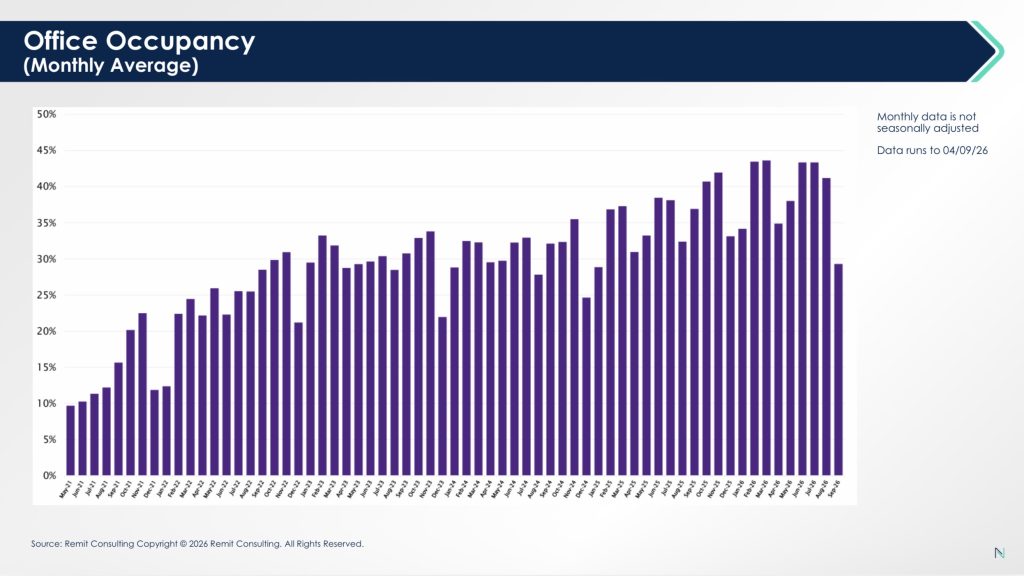
Newsteer’s September 2026 Monthly Office Occupancy Report records summer occupancy at around 41–42%, with levels expected to move back towards 45% as schools fully reopen and more employees return to their usual working patterns. This points to a return to the established range, rather than a structural increase in office demand.
Attendance policies are diverging
Some employers are increasing their attendance requirements. Hargreaves Lansdown is moving 2,400 employees to three office days a week from early 2027, while TikTok is introducing a five-day requirement for most US employees. Other businesses continue to retain hybrid models.
However, mandates do not guarantee utilisation. Civil Service attendance remains below its 60% target, demonstrating the potential gap between formal policy and actual workplace use.
Demand also remains uneven across the working week. Tuesday to Thursday continue to attract the highest attendance, while Mondays and particularly Fridays are quieter. This pattern continues to influence capacity planning, workplace services and the employee experience.
AI is changing the space equation
AI could make the relationship between growth and office demand less direct. Higher productivity and weaker recruitment in some AI-exposed roles may enable businesses to increase output without a corresponding rise in office-based headcount.
Occupiers may therefore encourage greater attendance while requiring less space overall, or a different type of space configured around collaboration, quality and changing working practices.
#OurSteer
As organisations encourage greater office attendance, workplace quality will become an increasingly important differentiator, while AI may further weaken the traditional link between business growth and office space requirements.
Occupiers should consider attendance policy, actual utilisation and future workforce requirements together. Landlords, investors and developers should focus on adaptable, high-quality workplaces capable of competing for demand, even if the overall requirement for space does not increase.