The London residential development market continued to show signs of activity during Q3 2026, with planning permissions rising across the capital. However, weak buyer demand, constrained affordability and continued viability pressures mean that converting those permissions into new homes remains challenging.
Planning activity strengthened during the quarter, with 5,199 units granted permission across London, up 12% on Q2. Outer London continued to drive activity, with 4,156 units approved, also up 12% quarter-on-quarter, while Inner London permissions fell by 10% to 1,043 units. The divergence highlights the continued viability challenges facing higher-density development in central locations.
Construction activity remains subdued. Starts in Inner London fell slightly during Q3 and remained behind Outer London, while completions continue to significantly outpace starts. Without a sustained recovery in new development starts, this imbalance points towards an increasing risk of housing undersupply in the years ahead.
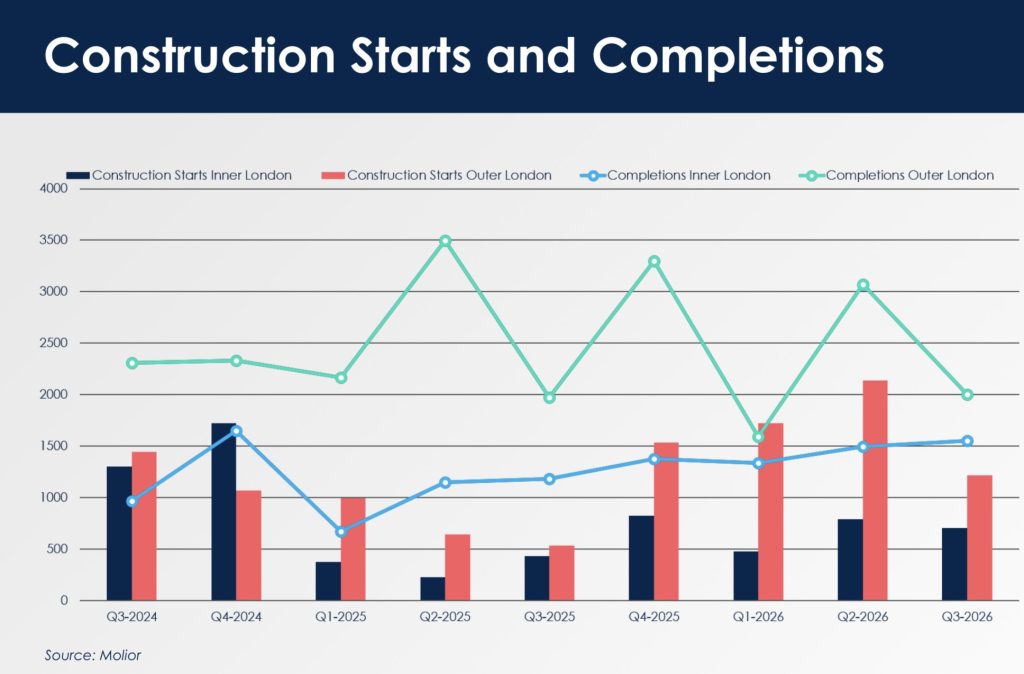
Viability remains at the centre of the challenge, but sales risk is becoming increasingly important for developers. Buyer demand remains weak as affordability pressures and higher mortgage costs weigh on confidence. Bulk transactions are consequently playing a greater role in the new-build market, while developers remain cautious about starting taller market-sale schemes without greater certainty over their affordable housing and exit strategy.
There are, however, some reasons for cautious optimism. The revised National Planning Policy Framework provides a stronger focus on station-led development and more consistent decision-making, while support for major infrastructure projects including the Bakerloo Line extension and West London Orbital could create longer-term opportunities for growth. The Brownfield Land Release Fund 3, meanwhile, provides further funding to help councils unlock publicly owned brownfield land for housing.
Looking ahead to Q4 and into 2027, policy clarity will be important. The outcome of the Social and Affordable Homes Programme allocations for London should provide a clearer indication of which councils and registered providers have the funding to progress affordable-led schemes and estate regeneration. The introduction of the Building Safety Levy will add another cost that needs to be factored into viability from the outset, while proposed changes to the National Scheme of Delegation could help streamline planning decisions.
For the immediate future, lower-density, amenity-light and affordable-led schemes are likely to offer some of the clearest routes to delivery. London continues to demonstrate strong underlying housing need, but ensuring that planning permissions translate into starts will require viable schemes, secure exit strategies and greater confidence across both the development and sales markets.